


 English
 русский
 Español
 Deutsch
 عربى
-
A Rocker Switch is a compact and easy-to-operate manual control component. Its unique rocker-style actuation, combined with a toggle or momentary reset function, allows users to quickly switch circuit...View More >>
-
A micro switch is a small mechanical switch with a fast action mechanism, which is widely used in household appliances, industrial automation, automotive electronics, medical equipment, and other fiel...View More >>
-
The baby stroller gear switch is an innovative product independently developed by our company. We have applied for invention patents both domestically and internationally, which fully demonstrates the...View More >>
-
Push button switches are widely used in various control systems with their diverse structural designs, high-strength material selection, and excellent performance. The products are available in a vari...View More >>
-
The internal structure of the piano key switch mostly adopts a mechanical or light-touch design. Some high-end models use capacitive sensing technology to achieve contactless operation, thereby improv...View More >>
-
The knob switch adopts a high-sensitivity rotary contact structure, which has smooth operation and clear positioning, ensuring that every adjustment is accurate. The product has excellent durability a...View More >>
-
The KM trigger switch is a universal high-current switch designed for high-power power tools, with excellent current carrying capacity and stable performance. The internal fast-action structure ensure...View More >>
-
A door control switch, also known as a door magnetic switch or door status sensor, is a key electrical component widely used in industrial control, security systems, intelligent building automation, a...View More >>
-
The wiring harness is an overall wiring assembly that integrates multiple wires, cables, terminals, and connectors according to specific electrical design and mechanical structure requirements. It is ...View More >>
-
PCB control board is one of the indispensable core components in modern electronic devices. As the brain of the control system, it is widely used in many fields such as industrial automation, consumer...View More >>
NEWS
 Home / News / Industry News / Automotive Switches: A Guide to Choosing and Wiring Reliable 12V and 24V Controls
Automotive Switches: A Guide to Choosing and Wiring Reliable 12V and 24V Controls
 2026.11.12
 Industry News
Automotive switches look simple from the driver's seat. A flick, a press, a click, and a lamp, pump, or motor does what it should. Under the panel, that small component has to survive vibration, temperature swings, dust, and the occasional spilled coffee while making and breaking current cleanly for years. Whether you are specifying a 12V auxiliary circuit, a 24V work-truck system, or a low-current sensing path, the useful questions stay the same: what is being switched, how often, and in what kind of environment?
Content
What Makes an Automotive Switch Different
A switch that lives in a vehicle is not simply a household switch with a different connector. It works in a direct-current system, often 12V or 24V, and it sees loads that are rarely purely resistive. Lamp filaments draw a surge at switch-on. Motors and solenoids produce inductive kickback when switched off. A contact pair that looks adequate on a bench can pit quickly if the load is misunderstood.
Mechanical conditions matter just as much. A door switch may see thousands of short cycles and very little current. A dash switch may sit in sunlight, then face a cold morning start. A pedal or latch switch may be expected to repeat its travel millions of times without drifting out of adjustment. That is why contact material, spring geometry, terminal plating, and housing sealing deserve as much attention as the current rating on the label.
- Electrical load: continuous current, inrush current, and whether the load is resistive, inductive, or lamp-based.
- Environment: temperature range, humidity, dust, splash, salt, and vibration at the mounting point.
- Human interface: how much travel, force, and tactile feedback the driver or technician needs.
- Service life: cycle count and the consequence of a missed or stuck contact.
These factors are not independent. A tightly sealed switch may feel heavier. A high-current switch may be larger. A very light momentary action may be pleasant for a horn but wrong for a master isolator. Good selection is a balance, not a single number.
Poles, Throws, and Switching Action in Plain Terms
The vocabulary sounds technical, but it answers two practical questions: how many circuits the switch can control, and whether it stays where you put it. Once those points are clear, the datasheet becomes much easier to read.
| Configuration | What it does | Typical use |
|---|---|---|
| SPST | One circuit, simple on or off | Interior lamp, accessory socket, isolated feed |
| SPDT | One input switched between two outputs | High/low selection, changeover between sources |
| DPST | Two circuits switched together | Paired lamps, positive and negative isolation |
| DPDT | Two circuits, two positions, with changeover | Reversing motor, polarity change, two-speed fan |
| Momentary | Springs back when released | Horn, start request, window jog, reset |
| Maintained | Stays where it is set | Master lighting, fan speed, mode selection |
If a switch is described only as “on/off,” ask whether it is momentary or maintained. That one detail prevents a surprising amount of rework.
Common Switch Types in Vehicle Electrical Systems
Most cabins, engine bays, and utility bodies use a handful of familiar switch families. The right choice usually comes down to panel space, current, sealing, and the feel the operator expects.
Rocker switches
Rocker switches suit dashboard and console panels because they can be snapped in, illuminated, and shaped to a clean interior line. A two-position rocker handles a simple accessory circuit; a three-position rocker can select OFF–LOW–HIGH or another multi-mode function. Look for secure detents, clear legends, and a body depth that fits the panel without stressing the terminals.
 R11-22 Three-Position Rocker Power SwitchThree-position rocker switch for High/STOP/Low speed control, with standardized terminals and UL, S, CE, and CQC ratings for appliance use.View Product →
For compact electronic devices and shallow panels, smaller rocker bodies help without giving up a positive click.
 Compact R11-15 Rocker Switch for AppliancesCompact rocker switch with SPDT/SPST options and protective-cover or internal dustproof variants for household appliances and office equipment.View Product →
Toggle switches
Toggle switches remain popular in off-road, commercial, and utility vehicles because they offer a strong, visible action that is easy to operate with gloves. A boot or sealed bezel is worth considering where dust and moisture are present. The lever should feel firm at each detent, with no vague midpoint that invites accidental changes.
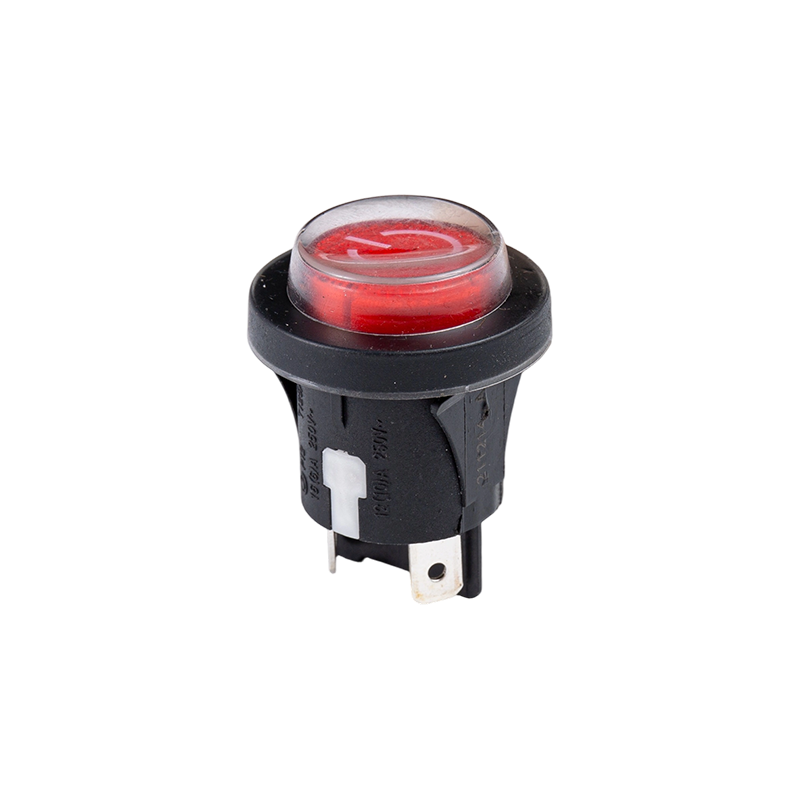
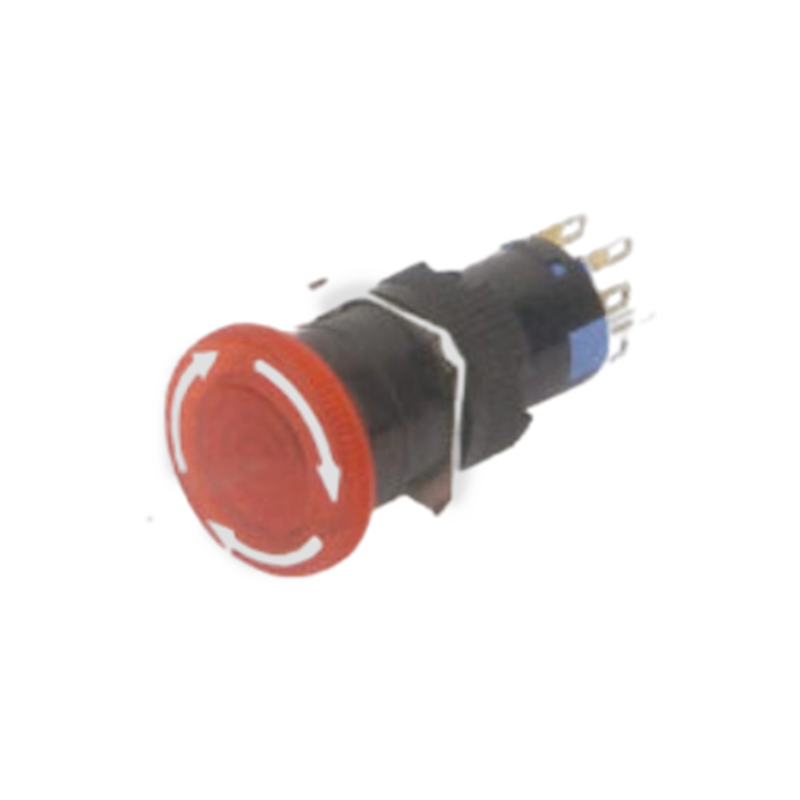
Push-buttons are natural for brief commands: horn, start request, reset, or a mode step. Momentary action gives clear feedback, but the location matters. A button placed where a knee or elbow can brush it may need a guard, a recess, or a higher actuation force. For repeated use, the internal contact bridge and spring should be designed for the cycle count, not just the first few hundred presses.
Micro and limit switches
Micro switches do the quiet work of detection. They confirm that a door is closed, a hood is latched, a seat is occupied, a pedal has moved, or a glovebox has shut. The actuator shape matters as much as the switch body: a lever, roller, or simulated hinge can compensate for imperfect alignment and reduce wear. Sealing and terminal protection are important in footwells, door jambs, and underbody areas.
 MS15-3B1 High-Sensitivity Micro Switch for Power ToolsCompact high-sensitivity micro switch for low-force position sensing and DC power tools, with stable electrical performance and UL, TUV, KC, and CQC certifications.View Product →
For a deeper look at the engineering behind these tiny mechanisms, our technical note on high-precision micro switch design is a useful next read.
Rotary and ignition switches
Rotary switches handle keyed ignition, mode selection, and multi-position control. A good rotary feel comes from clean detents, a clear shaft keyway, and contacts that do not hesitate between positions. Ignition-related designs also need to consider anti-restart behavior and the consequences of a worn key or forced rotation.
A Practical Selection Checklist
Before requesting samples, gather the details that will shape the part. A short checklist saves several rounds of questions later.
- Load and current: record continuous current, inrush, and whether the load is inductive or lamp-based.
- System voltage: confirm nominal 12V or 24V, and ask about transient conditions in the vehicle.
- Switching action: decide between momentary and maintained, and confirm the number of positions.
- Poles and throws: map the circuit so the switch does not need an external workaround.
- Panel and mounting: check cutout size, body depth, snap-in or screw fixing, and terminal clearance.
- Sealing and temperature: match the IP expectation and thermal range to the actual mounting location.
- Connection method: choose tabs, pins, lead wires, or a harness interface that fits assembly.
- Life and documentation: confirm cycle target, test data, and any programme-specific quality documents.
Testing, Documentation, and the Questions Worth Asking
A catalogue switch is not automatically an automotive-qualified part. The documentation should match the programme. Ask for contact resistance, insulation resistance, dielectric withstand, operating force, travel, and life-test results where they are available. For under-hood or exterior locations, vibration and thermal cycling data are more informative than a general “durable” claim. Salt spray and sealing reports help where road splash is expected.
It is also reasonable to ask how the switch behaves at the end of its life. Does it fail open, fail closed, or become intermittent? For a courtesy lamp, an intermittent contact may be an annoyance. For a latch or pedal signal, it may be a safety concern. That answer should influence both the switch choice and the system-level fallback.
At Shanghai Qijia Electronics, our range includes rocker switches, micro switches, push-buttons, knob switches, door-control switches, wiring harnesses, and PCB control boards. We are happiest when the conversation starts with the application rather than the part number, because small details in mounting or load often point to a better fit.
A Calm Approach to a Small but Critical Part
Automotive switches reward careful specification. Start with the load, the environment, and the feel the user needs. Then match the configuration, sealing, mounting, and documentation to the programme. A switch that is modest in cost but well matched will usually outperform a more expensive part chosen in a hurry.
You can browse the full switch range to compare families, or send us the application details and we will help narrow the options. No hard sell, just a practical conversation about what the switch has to do.



A Appliance Switches Manufacturer that has been focusing on the development, production and sales of Switches for 21 years;
Products Links
Contact Information
Tel: +86-021-33752188
Phone: +86-13524812989
E-Mail: [email protected]
[email protected]
[email protected]Address: No. 580 Shenzhou Road, Fengxian District, Shanghai, China

