


 English
  русский
  Español
  Deutsch
  عربى
عربى -
A Rocker Switch is a compact and easy-to-operate manual control component. Its unique rocker-style actuation, combined with a toggle or momentary reset function, allows users to quickly switch circuit...View More >>
-
A micro switch is a small mechanical switch with a fast action mechanism, which is widely used in household appliances, industrial automation, automotive electronics, medical equipment, and other fiel...View More >>
-
The baby stroller gear switch is an innovative product independently developed by our company. We have applied for invention patents both domestically and internationally, which fully demonstrates the...View More >>
-
Push button switches are widely used in various control systems with their diverse structural designs, high-strength material selection, and excellent performance. The products are available in a vari...View More >>
-
The internal structure of the piano key switch mostly adopts a mechanical or light-touch design. Some high-end models use capacitive sensing technology to achieve contactless operation, thereby improv...View More >>
-
The knob switch adopts a high-sensitivity rotary contact structure, which has smooth operation and clear positioning, ensuring that every adjustment is accurate. The product has excellent durability a...View More >>
-
The KM trigger switch is a universal high-current switch designed for high-power power tools, with excellent current carrying capacity and stable performance. The internal fast-action structure ensure...View More >>
-
A door control switch, also known as a door magnetic switch or door status sensor, is a key electrical component widely used in industrial control, security systems, intelligent building automation, a...View More >>
-
The wiring harness is an overall wiring assembly that integrates multiple wires, cables, terminals, and connectors according to specific electrical design and mechanical structure requirements. It is ...View More >>
-
PCB control board is one of the indispensable core components in modern electronic devices. As the brain of the control system, it is widely used in many fields such as industrial automation, consumer...View More >>
NEWS
 Home / News / Industry News / Waterproof Button Switch: Everything You Need to Know Before You Buy or Install One
Waterproof Button Switch: Everything You Need to Know Before You Buy or Install One
 2026.05.12
 Industry News
Content
- 1 What Makes a Button Switch Truly Waterproof?
- 2 Understanding IP Ratings for Waterproof Push Button Switches
- 3 Types of Waterproof Button Switches and How They Differ
- 4 Materials and Construction: What the Switch Body and Button Are Made From
- 5 How to Wire a Waterproof Push Button Switch Correctly
- 6 Panel Cutout Sizes and Mounting: Getting the Installation Right
- 7 Key Applications for Waterproof Button Switches
- 8 How to Choose the Right Waterproof Button Switch: A Decision Framework
- 9 Maintenance and Troubleshooting Waterproof Push Button Switches
What Makes a Button Switch Truly Waterproof?
A waterproof button switch is an electrical switching component specifically engineered to prevent water, moisture, dust, and other contaminants from reaching its internal contacts and mechanisms. Standard push button switches have exposed gaps around the actuator stem and between the body and the mounting panel — more than enough for water to penetrate and corrode contacts, short-circuit connections, or cause complete switch failure. A properly designed waterproof push button switch eliminates these vulnerabilities through a combination of sealed housings, elastomeric O-rings, silicone boots, and gasketed panel mounting systems that block ingress pathways entirely.
The distinction between "water-resistant" and "waterproof" matters enormously in practice. A water-resistant switch might tolerate an occasional light splash but will fail under sustained exposure to rain, spray, or immersion. A genuinely waterproof button switch maintains full electrical functionality when submerged, high-pressure washed, or continuously exposed to outdoor weather — depending on its specific ingress protection rating. The degree of protection is not a marketing claim; it is a standardized, testable performance specification defined by the International Electrotechnical Commission (IEC) standard 60529 and expressed as an IP code.
The sealing in a waterproof momentary push button switch must accommodate a mechanical paradox: the button must move freely enough to actuate reliably under finger pressure, yet the gap around the moving stem must be sealed tightly enough to block water entry. This is achieved through flexible silicone seals or rubber boots that compress and stretch with each actuation cycle without allowing water to follow the stem into the switch body. Over millions of actuation cycles, the integrity of this seal is the primary determinant of whether the switch continues to provide reliable waterproof protection throughout its operational life.
Understanding IP Ratings for Waterproof Push Button Switches
When selecting a waterproof button switch, the IP (Ingress Protection) rating is the single most important specification to understand. The IP code consists of two digits: the first indicates protection against solid particles (dust), and the second indicates protection against liquids (water). A higher number means better protection. Knowing what each rating level means in practical terms prevents both under-specifying (choosing a switch that fails in its environment) and over-specifying (paying for protection you don't need).
| IP Rating | Water Protection Level | Test Condition | Typical Application |
| IPX3 | Spraying water | Water sprayed at up to 60° from vertical | Sheltered outdoor equipment |
| IPX4 | Splashing water | Water splashed from any direction | Outdoor panels, marine dashboards |
| IP65 | Water jets | Low-pressure jet from any direction | Industrial controls, outdoor signage |
| IP66 | Powerful water jets | High-pressure jet from any direction | Washdown environments, food processing |
| IP67 | Temporary immersion | Submerged up to 1 meter for 30 minutes | Marine, outdoor, wet industrial areas |
| IP68 | Continuous immersion | Submerged beyond 1 meter (manufacturer specified) | Submersible equipment, underwater controls |
| IP69K | High-pressure steam jets | 80–100 bar steam wash at close range | Food/beverage, pharmaceutical washdown |
For most outdoor and general industrial applications, IP65 or IP67 waterproof button switches represent the practical sweet spot — robust enough to handle rain, hosing down, and accidental immersion, without the added cost of IP68 or IP69K ratings that are only needed in genuinely submerged or steam-wash environments. The first digit matters too: IP67 is also fully dust-tight (first digit 6), which is critical in environments with fine particles, metal shavings, or powder contamination that can work their way into switch mechanisms just as harmfully as water.
Types of Waterproof Button Switches and How They Differ
Waterproof push button switches come in several functional and mechanical configurations. Understanding these distinctions ensures you select the right switching behavior for your circuit, not just the right IP rating for your environment.
Momentary vs. Latching (Maintained) Waterproof Switches
This is the most fundamental functional distinction in any push button switch, waterproof or otherwise:
- Momentary waterproof push button switches only complete the circuit while the button is actively depressed. Release the button and the circuit immediately opens (or closes, in a normally-closed configuration). These are used wherever an action should occur only during the press — triggering a doorbell, activating a pump while held, sending a signal to a controller, or operating a horn. They are the most commonly specified type in control panels and equipment interfaces.
- Latching waterproof button switches (also called maintained or alternate-action switches) toggle state with each press — press once to switch ON, press again to switch OFF. The switch mechanically locks in each position until the next press. These are used for power on/off functions, motor start/stop controls, and any application where the switched state needs to persist without the operator holding the button.
Normally Open (NO) vs. Normally Closed (NC) Configurations
Waterproof push button switches are available in normally open (NO), normally closed (NC), and combined NO+NC configurations. In a normally open switch, the circuit is open (no current flows) at rest, and pressing the button closes the circuit. In a normally closed switch, the circuit is closed (current flows) at rest, and pressing the button opens it. Many industrial-grade sealed push button switches offer both NO and NC contacts simultaneously on separate terminals, allowing a single switch to control two independent circuit functions or to implement fail-safe logic. For safety stop functions, normally closed contacts are often preferred — a broken wire or switch failure opens the circuit and triggers the stop condition automatically.
Illuminated Waterproof Push Button Switches
Many waterproof button switch designs integrate an LED directly into the button cap, providing visual status indication alongside switching function. Illuminated switches serve two purposes: they make the button visible and locatable in dark or low-light environments, and they provide circuit state feedback to the operator — a lit button might indicate that a system is powered, a process is running, or an alarm is active. LED-illuminated waterproof push buttons are available in a wide range of colors (red, green, blue, yellow, white) and can be wired to illuminate independently of the switch circuit or in direct response to the switched state. The LED sealing must match the switch body rating — a switch body rated IP67 with a poorly sealed LED lens assembly provides no real IP67 protection.
Panel Mount vs. Cable-Mount Waterproof Switches
Most waterproof button switches are designed for panel mounting — they pass through a drilled hole in an enclosure panel and are secured from behind with a nut or clip, with the sealing gasket between the switch body flange and the panel surface. The panel itself becomes part of the sealing system, which is why the panel material, thickness, and surface finish all affect the integrity of the installation. Some specialized waterproof momentary push button switches are designed for inline cable mounting or DIN rail mounting, intended for applications where a panel-mounted solution isn't practical — such as handheld pendants, machine-mounted operator controls, or portable equipment.
Materials and Construction: What the Switch Body and Button Are Made From
The materials used in a waterproof push button switch determine not just its protection level but its chemical resistance, mechanical durability, temperature range, and lifespan in its operating environment. Budget switches and premium industrial switches may both claim the same IP rating, but their real-world performance over years of use diverges dramatically based on material quality.
Switch Body Materials
- Stainless steel (304 or 316 grade): The gold standard for demanding environments. Stainless steel switch bodies offer excellent corrosion resistance, high mechanical strength, and resistance to UV degradation. Grade 316 stainless provides superior resistance to chloride-induced corrosion, making it the preferred choice for marine applications, coastal installations, and chemical processing environments. The surface is easy to clean and resistant to most industrial chemicals. The main trade-off is higher cost compared to plastic alternatives.
- Brass (nickel or chrome plated): Widely used in mid-range waterproof panel switches. Brass has good machinability for producing precise threaded bodies and maintains dimensional stability well. Plating provides corrosion resistance, though the plating can chip or wear in harsh environments, exposing the underlying brass to oxidation. Not suitable for salt spray or chemical exposure without protective coatings.
- High-performance plastics (nylon, ABS, polycarbonate, POM): Plastic-bodied waterproof button switches offer light weight, inherent corrosion resistance, and electrical isolation of the switch body from the mounting panel — important in applications where panel grounding or electrical isolation is a concern. Quality industrial plastic switches use UV-stabilized compounds that resist sunlight degradation over years of outdoor exposure. Less suitable for environments with mechanical impact risk, solvents, or very high temperatures.
Button Cap and Actuator Materials
The button cap — the part the operator touches — is typically made from high-impact plastic, silicone rubber, or metal. Silicone rubber caps are the most common sealing approach for waterproof momentary push buttons: the entire cap is a flexible membrane that depresses to actuate the internal switch while providing a continuous water-tight barrier. Metal button caps with O-ring seals provide a more industrial appearance and greater impact resistance but require precise O-ring compression to maintain their IP rating. Color-coding of button caps is a standardized safety practice in industrial control: red for stop/emergency, green for start, yellow for caution/reset, blue for mandatory action.
Internal Contact Materials
Inside the waterproof push button switch, the electrical contacts that carry the switched current are most commonly made from silver alloy (silver-nickel, silver-cadmium oxide, or silver tin oxide). Silver alloys provide low contact resistance, good arc-quenching properties, and excellent conductivity. The contact rating — expressed in voltage and current capacity — must be matched to the circuit load. Using an under-rated switch contact in a high-current application causes contact welding, arcing damage, and premature failure. Gold-plated contacts are used in low-current signal-level applications where even the thin silver oxide layer that forms on silver contacts would add unacceptable resistance to microamp-level signals.
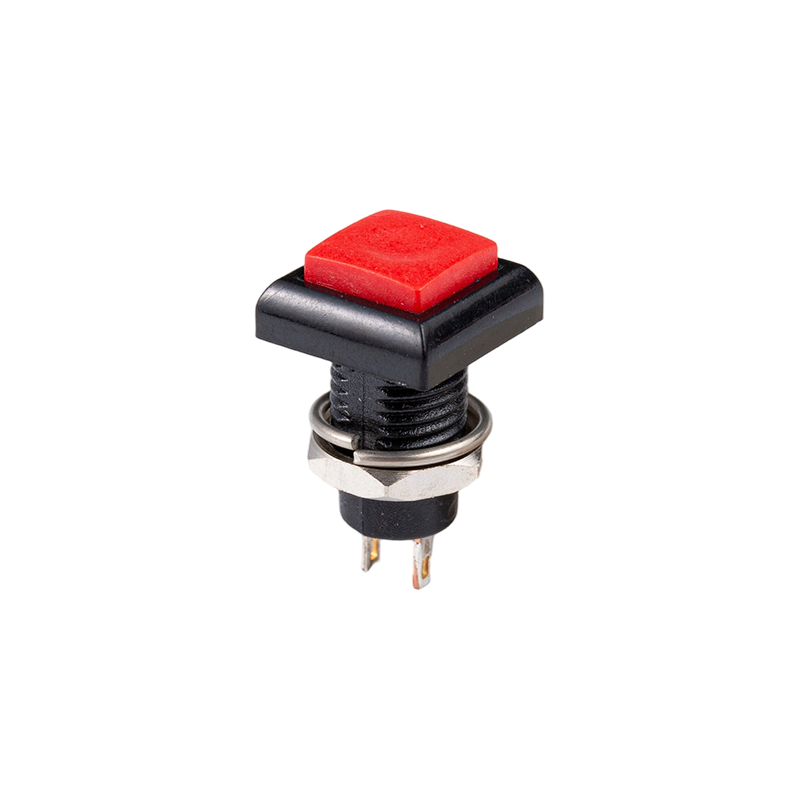
How to Wire a Waterproof Push Button Switch Correctly
Correct wiring is just as important as correct switch selection. A properly rated IP67 waterproof button switch installed with poorly sealed cable entries or incorrectly terminated connections will fail just as surely as an under-rated switch. Here's a practical guide to getting the wiring right:
Understanding the Terminal Layout
Most waterproof push button switches have screw terminals or quick-connect (spade) terminals at the rear. A basic momentary NO switch has two terminals — one for the incoming wire and one for the outgoing wire. Switches with both NO and NC contacts typically have three terminals: a common (COM), a normally open (NO), and a normally closed (NC). Illuminated switches add two more terminals for the LED positive and negative connections. Always identify terminals from the manufacturer's datasheet before wiring — many switches have the terminal designations molded into the switch body or printed on a label, but these markings can be ambiguous without the datasheet for confirmation.
Cable Entry and Sealing at the Rear
The front face of a panel-mounted waterproof button switch is sealed by its gasket against the panel. The rear — where the wiring connects — is only as waterproof as the enclosure it sits in. If the switch is mounted in an IP-rated enclosure, the enclosure cable glands handle rear sealing. If the switch is mounted in an open panel or used without an enclosure, the cable entry at the rear terminals must be independently sealed. Some waterproof push button switch designs include a sealed rear cap or boot that provides IP protection at the terminal end; others rely entirely on the enclosure. Confirm which approach applies to your specific switch and installation before assuming the rear is protected.
Basic Wiring Configurations
- Simple momentary circuit: Connect one terminal of the switch to the positive supply (or signal line) and the other terminal to the load or input. When pressed, current flows through the switch to complete the circuit. This is the standard configuration for doorbell buttons, machine start buttons, and signal triggers.
- Illuminated switch (LED powered from switched circuit): Connect the LED positive terminal to the output side of the switch contact (after the NO contact) and the LED negative to ground. The LED illuminates only when the switch is pressed and the circuit is complete. This provides direct visual confirmation of switch activation.
- Illuminated switch (LED always on): Connect the LED terminals directly across the supply voltage (with a current-limiting resistor calculated for the supply voltage and LED forward voltage if not already built into the switch). The LED glows continuously as a locator light regardless of switch state, while the switch contact operates independently.
- NC safety stop circuit: Connect the normally closed terminals in series with the safety circuit. Under normal conditions, current flows through the closed contacts and the system operates. Pressing the button opens the NC contact, breaking the circuit and triggering the stop condition. A broken wire achieves the same result — an inherently fail-safe design.
Wire Gauge and Terminal Torque
Use wire gauge appropriate for the switched current load — never smaller. For low-voltage control circuits under 1A, 22–24 AWG is typical. For power circuits up to 10A, 18–16 AWG is standard. Tighten screw terminals to the torque specification in the datasheet — under-torqued connections create high resistance, heat, and arcing; over-torqued connections damage terminal threads or crack plastic terminal blocks. In vibrating or outdoor environments, use ferrules (wire end sleeves) on stranded wire before inserting into screw terminals to prevent individual strands from escaping the terminal clamp and causing shorts or connection failure over time.
Panel Cutout Sizes and Mounting: Getting the Installation Right
Waterproof button switches are available in standardized mounting thread diameters that correspond to specific panel cutout hole sizes. The most common sizes in industrial and commercial use are 16mm, 19mm, 22mm, and 30mm thread diameter — referring to the threaded body that passes through the panel hole. Using the correct hole size is essential: too large and the mounting gasket cannot seal properly; too small and the switch body won't fit through. The panel thickness must also fall within the switch's specified range — most switches specify a minimum and maximum panel thickness (typically 1–6mm) to ensure the mounting nut achieves adequate gasket compression without bottoming out on the thread.
Drill or punch the mounting hole cleanly with smooth edges — rough or burred edges damage the sealing gasket and compromise the IP rating immediately. For high-volume production panel builds, punch tools that produce a clean, burr-free hole are worth the investment. In field installations, a step drill or hole saw followed by deburring produces acceptable results. After installing the switch, confirm that the sealing gasket is fully seated between the switch flange and the panel surface all the way around — any gap or lifted edge of the gasket creates a water ingress path that defeats the switch's IP rating regardless of the switch body's own sealing integrity.
Key Applications for Waterproof Button Switches
Sealed push button switches appear across an enormous range of industries and products. Understanding typical application requirements helps clarify which specifications matter most for each use case:
- Marine and boat controls: Helm control panels on boats face constant spray, salt air, rain, and occasional submersion. Marine-grade waterproof push button switches require at least IP66 or IP67 rating, stainless steel or high-quality UV-stable plastic bodies, and resistance to salt water corrosion. The 316-grade stainless steel is specifically preferred in salt water environments where 304-grade stainless can develop surface corrosion over time.
- Outdoor access control and intercoms: Gate openers, doorbell buttons, keypad entry systems, and intercom call buttons mounted on exterior walls or gate posts experience full weather exposure year-round. IP65 or IP67 waterproof momentary push button switches are the standard here, often with illuminated caps for nighttime visibility. UV resistance of the button cap material is critical — non-UV-stabilized plastics yellow, crack, and lose sealing integrity within 2–3 years of sunlight exposure.
- Industrial machinery and equipment panels: Machine tool controls, conveyor system panels, hydraulic press controls, and production line operator interfaces use waterproof panel switches to survive coolant spray, lubricating oil mist, washdown cleaning, and general industrial contamination. IP65 is typically the minimum required; IP66 or IP69K for dedicated washdown applications in food processing, beverage, or pharmaceutical environments.
- Agricultural and outdoor power equipment: Tractors, irrigation controllers, outdoor lighting systems, and farm equipment controls need switches that survive rain, mud, dust, vibration, and temperature extremes from well below freezing to desert heat. IP67 with a wide operating temperature range (typically −25°C to +85°C) and stainless or robust plastic construction is the appropriate specification.
- Consumer electronics and DIY projects: Waterproof momentary push button switches are widely used in custom electronics projects, home automation systems, outdoor LED controls, aquarium equipment, and portable device builds. For these applications, smaller 12mm or 16mm format switches rated IP67 in stainless steel or plastic are popular, offering reliable waterproofing at accessible price points for hobbyist and small-production use.
- Medical and laboratory equipment: Equipment used in clinical or laboratory washdown environments requires switches that survive regular disinfectant spray cleaning. IP67 or IP69K ratings are standard, along with chemical resistance to common disinfectants (bleach solutions, isopropyl alcohol, hydrogen peroxide) that degrade many standard plastics. Smooth, crevice-free surfaces are also prioritized to prevent bacterial harboring.
How to Choose the Right Waterproof Button Switch: A Decision Framework
With so many options available, narrowing down the right waterproof push button switch for a specific application comes down to systematically answering a set of practical questions. Work through this decision framework before purchasing:
| Decision Factor | Questions to Answer | Implication for Spec |
| Environment | Indoor/outdoor? Rain, spray, or submersion? Dust or chemical exposure? | Sets minimum IP rating required |
| Switching Function | Should it stay on after press, or only while held? | Momentary vs. latching type |
| Circuit Type | Voltage level? Current load? AC or DC? | Contact voltage/current rating |
| Indication Needed | Does the operator need visual feedback or location lighting? | Illuminated vs. non-illuminated; LED color |
| Panel Requirements | What hole size is available or preferred? Panel thickness? | Thread diameter (16/19/22/30mm) |
| Material Compatibility | Salt water? Solvents? UV exposure? Impact risk? | Body material: 316 SS, plastic, brass |
| Operating Life | How many actuations per day/year? Mission critical? | Mechanical life rating (cycles); brand quality tier |
One additional practical consideration: always buy from manufacturers or suppliers who publish complete datasheets with test standards referenced, not just marketing claims. A switch that lists "IP67" with no reference to IEC 60529 testing methodology or independent certification should be treated with skepticism, especially for safety-critical or mission-critical applications. Reputable manufacturers like Schurter, EAO, Apem, Omron, and ABB publish full environmental test data and provide traceable product certifications. For less critical applications, well-reviewed mid-tier brands backed by genuine test data provide reliable performance at significantly lower cost than top-tier industrial brands — but the datasheet transparency standard should still be applied regardless of price point.
Maintenance and Troubleshooting Waterproof Push Button Switches
A well-specified and correctly installed waterproof button switch is largely maintenance-free throughout its service life. However, when problems do occur, they tend to fall into a predictable set of failure modes that are straightforward to diagnose and resolve.
- Switch fails to actuate or feels stiff: Usually caused by debris, corrosion, or seal degradation around the button stem. In outdoor installations, sand, grit, or mineral deposits can work into the actuator gap over time. Clean the button cap and surrounding area with compressed air or a soft brush. If a silicone boot seal has hardened or cracked with age, the switch should be replaced — attempting to operate a switch with a compromised seal risks water ingress to the contacts on the next rain or wash event.
- Intermittent or no electrical contact: In a switch that actuates mechanically but doesn't reliably make electrical contact, the most likely causes are corroded contacts (indicating the sealing has failed and moisture has reached the contact chamber), loose terminal connections, or contact welding from a previous overcurrent event. Use a multimeter in continuity mode to confirm whether the switch contacts are opening and closing correctly with actuation — if contact resistance is high or erratic, replacement is indicated.
- LED fails or flickers in illuminated switches: Check supply voltage to the LED terminals against the LED's rated voltage. LEDs driven above their rated forward voltage burn out rapidly. In AC circuits, confirm a rectifying diode or appropriate AC-rated LED driver is used — most LEDs are DC devices and will fail quickly on unrectified AC. If voltage is correct and the LED still fails, the LED element itself has reached end of life and the switch should be replaced.
- Water ingress despite IP-rated switch: The switch body itself is rarely the entry point when a supposedly waterproof installation fails. More commonly, the panel gasket was not properly seated during installation, the panel hole was oversized or rough-edged, the mounting nut was insufficiently tightened, or the rear terminal area was exposed without adequate enclosure protection. Systematically inspect the gasket seating, panel hole quality, mounting nut torque, and cable entry point at the rear before concluding the switch itself has failed.
Choosing and installing the right waterproof button switch is an investment in long-term reliability. Take the time to match the IP rating to the actual environment, select appropriate materials for the chemical and mechanical conditions, wire the terminals correctly with proper cable management, and install the panel gasket with care. A switch that costs a few dollars more upfront but lasts a decade in a demanding outdoor or industrial environment is always the better value over a cheap switch that fails in its first winter — taking down equipment and requiring an inconvenient mid-season repair.

A Appliance Switches Manufacturer that has been focusing on the development, production and sales of Switches for 21 years;
Products Links
Contact Information
Tel: +86-021-33752188
Phone: +86-13524812989
E-Mail: [email protected]
[email protected]
[email protected]Address: No. 580 Shenzhou Road, Fengxian District, Shanghai, China

