


 English
  русский
  Español
  Deutsch
  عربى
عربى -
A Rocker Switch is a compact and easy-to-operate manual control component. Its unique rocker-style actuation, combined with a toggle or momentary reset function, allows users to quickly switch circuit...View More >>
-
A micro switch is a small mechanical switch with a fast action mechanism, which is widely used in household appliances, industrial automation, automotive electronics, medical equipment, and other fiel...View More >>
-
The baby stroller gear switch is an innovative product independently developed by our company. We have applied for invention patents both domestically and internationally, which fully demonstrates the...View More >>
-
Push button switches are widely used in various control systems with their diverse structural designs, high-strength material selection, and excellent performance. The products are available in a vari...View More >>
-
The internal structure of the piano key switch mostly adopts a mechanical or light-touch design. Some high-end models use capacitive sensing technology to achieve contactless operation, thereby improv...View More >>
-
The knob switch adopts a high-sensitivity rotary contact structure, which has smooth operation and clear positioning, ensuring that every adjustment is accurate. The product has excellent durability a...View More >>
-
The KM trigger switch is a universal high-current switch designed for high-power power tools, with excellent current carrying capacity and stable performance. The internal fast-action structure ensure...View More >>
-
A door control switch, also known as a door magnetic switch or door status sensor, is a key electrical component widely used in industrial control, security systems, intelligent building automation, a...View More >>
-
The wiring harness is an overall wiring assembly that integrates multiple wires, cables, terminals, and connectors according to specific electrical design and mechanical structure requirements. It is ...View More >>
-
PCB control board is one of the indispensable core components in modern electronic devices. As the brain of the control system, it is widely used in many fields such as industrial automation, consumer...View More >>
NEWS

The Satisfying Click: A Deep Dive into Knob Switches
 2025.12.05
 Industry News
Content
What Exactly is a Knob Switch?
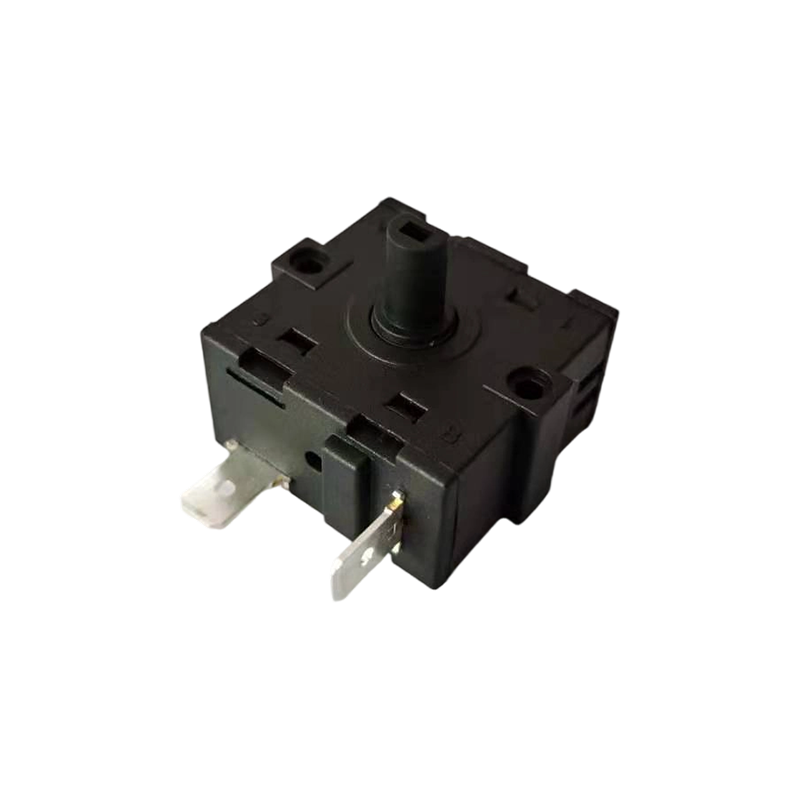
A knob switch, often simply called a rotary switch, is a type of electrical switch operated by turning a circular control—the knob. Unlike the simple push of a button or the flip of a toggle, a rotary switch allows a user to select from multiple discrete positions or settings. Think of the volume dial on an old stereo, the burner control on a stove, or the function selector on a washing machine.
The key to its function lies in its internal design: a spindle connected to the knob rotates a contact, which then touches one of several fixed contacts arranged in a circle. This completes a specific circuit corresponding to the chosen setting.
The Mechanics and Versatility of Rotation
How They Work: Poles and Throws
To understand the versatility of knob switches, we need to talk about poles and throws, terms used to describe any switch:
- Pole §: This refers to the number of separate circuits the switch can control simultaneously. A single-pole switch controls one circuit.
- Throw (T): This refers to the number of different positions or contacts that each pole can be connected to. A single-throw switch is simply on or off.
A knob switch is typically a multi-position switch. For example, a “single-pole, four-throw” (SP4T) rotary switch can control one circuit and connect it to one of four different destinations. This allows a single knob to select between four speeds, four different inputs (like on an audio receiver), or four separate functions.
The Feel of the Click
One of the most defining characteristics of a knob switch is the detent—that satisfying, mechanical click or snap you feel when you move from one position to the next. These detents are not just for show; they provide crucial tactile feedback, ensuring the user knows precisely which position they have selected without having to look at the knob. This mechanical assurance makes them ideal for tasks where precision is important, such as tuning a radio or selecting a laboratory instrument’s function.
A History of Control: Where We Find Them
The rotary switch has been a staple in electronics and mechanics for over a century, evolving with technology while maintaining its core function.
From Radios to Rigs: Classic Uses
In the early days of electronics, particularly with radios and televisions, the knob switch was king. It was used for power, volume, channel selection, and band switching (like AM/FM). The continuous, smooth-turning volume knob is a prime example of an analog control, gradually increasing or decreasing the current flow.
Modern Digital Knobs: The Encoder
While traditional rotary switches connect circuits, a modern cousin, the rotary encoder, performs a similar function in the digital age. Instead of connecting electrical contacts, an encoder generates a series of digital pulses as it is turned.
- Relative Encoders: These are commonly used today, often found as the volume control in car stereos or on computer peripherals. They don’t have fixed positions; instead, they tell the system how much and which direction they’ve been turned, allowing for continuous and rapid digital adjustment. They often include a push-button function for extra utility (like mute or reset).
- Absolute Encoders: These are more complex, reporting the exact angular position of the knob, making them invaluable in industrial settings, robotics, and complex control panels where a precise physical position must be mapped to a digital setting.
Why the Knob Persists
Despite the rise of touchscreens and digital controls, the knob switch remains popular for several compelling reasons:
- Tactile Efficiency: You can operate a physical knob without looking away from your primary task, relying purely on feel. This is a huge safety and convenience factor in cars and cockpits.
- Fine Control: For things like volume, temperature, or speed, the ability to make small, incremental adjustments by turning is often superior to tapping a digital screen multiple times.
- Durability: Being relatively simple mechanical devices, high-quality knob switches can withstand hundreds of thousands of turns, offering excellent long-term reliability in demanding environments.
From the simple on-off control of a desk lamp to the complex function selection in an airplane cockpit, the humble knob switch continues to be an essential interface that bridges the gap between the human hand and the control of electricity. Would you like to know more about the different types of materials used in the knobs themselves?

A Appliance Switches Manufacturer that has been focusing on the development, production and sales of Switches for 21 years;
Products Links
Contact Information
Tel: +86-021-33752188
Phone: +86-13524812989
E-Mail: [email protected]
[email protected]
[email protected]Address: No. 580 Shenzhou Road, Fengxian District, Shanghai, China

