


 English
  русский
  Español
  Deutsch
  عربى
عربى -
A Rocker Switch is a compact and easy-to-operate manual control component. Its unique rocker-style actuation, combined with a toggle or momentary reset function, allows users to quickly switch circuit...View More >>
-
A micro switch is a small mechanical switch with a fast action mechanism, which is widely used in household appliances, industrial automation, automotive electronics, medical equipment, and other fiel...View More >>
-
The baby stroller gear switch is an innovative product independently developed by our company. We have applied for invention patents both domestically and internationally, which fully demonstrates the...View More >>
-
Push button switches are widely used in various control systems with their diverse structural designs, high-strength material selection, and excellent performance. The products are available in a vari...View More >>
-
The internal structure of the piano key switch mostly adopts a mechanical or light-touch design. Some high-end models use capacitive sensing technology to achieve contactless operation, thereby improv...View More >>
-
The knob switch adopts a high-sensitivity rotary contact structure, which has smooth operation and clear positioning, ensuring that every adjustment is accurate. The product has excellent durability a...View More >>
-
The KM trigger switch is a universal high-current switch designed for high-power power tools, with excellent current carrying capacity and stable performance. The internal fast-action structure ensure...View More >>
-
A door control switch, also known as a door magnetic switch or door status sensor, is a key electrical component widely used in industrial control, security systems, intelligent building automation, a...View More >>
-
The wiring harness is an overall wiring assembly that integrates multiple wires, cables, terminals, and connectors according to specific electrical design and mechanical structure requirements. It is ...View More >>
-
PCB control board is one of the indispensable core components in modern electronic devices. As the brain of the control system, it is widely used in many fields such as industrial automation, consumer...View More >>
NEWS

Knob Switches Made Simple: How They Work, Types & How to Choose
 2026.04.08
 Industry News
Content
- 1 What Are Knob Switches and How Do They Work?
- 2 Main Types of Knob Switches
- 3 Key Electrical Specifications of Knob Switches
- 4 Materials and Construction of Knob Switches
- 5 Where Knob Switches Are Used: Key Applications by Industry
- 6 Maintained vs. Spring-Return Knob Switches: When to Use Each
- 7 Illuminated Knob Switches: Types and Practical Benefits
- 8 How to Choose the Right Knob Switch for Your Application
- 9 Installation, Wiring, and Maintenance Tips for Knob Switches
What Are Knob Switches and How Do They Work?
Knob switches are a category of electromechanical switching devices operated by rotating a knob — a projecting grip element — to select between two or more circuit positions. Unlike toggle or push-button switches that operate through linear motion, knob switches use rotary motion to change the internal contact configuration, directing electrical current through different circuits or varying resistance, voltage, or signal paths depending on the position the knob is turned to. The rotational motion makes them highly intuitive to operate, visually clear in their current setting, and mechanically robust — qualities that have made them a staple of control panels, industrial machinery, consumer appliances, and electronic instruments for well over a century.
The operating principle of a rotary knob switch centers on a rotating contact shaft connected to the knob. As the knob is turned, the shaft rotates an internal contact carrier or wiper that makes or breaks connections with fixed contact points arranged around the shaft at specific angular positions. The number of positions, the electrical load each contact must carry, the degree of rotation between positions, and whether the switch returns to a default position or stays wherever it is set are all design variables that differ between the many types of knob switches available. Understanding these variables is the foundation for selecting the right switch for any application.
Main Types of Knob Switches
The term "knob switch" encompasses several distinct switch families that share the rotary knob interface but differ significantly in their internal mechanism, electrical function, and intended application. Knowing the differences is essential before specifying or purchasing.
Rotary Selector Switch
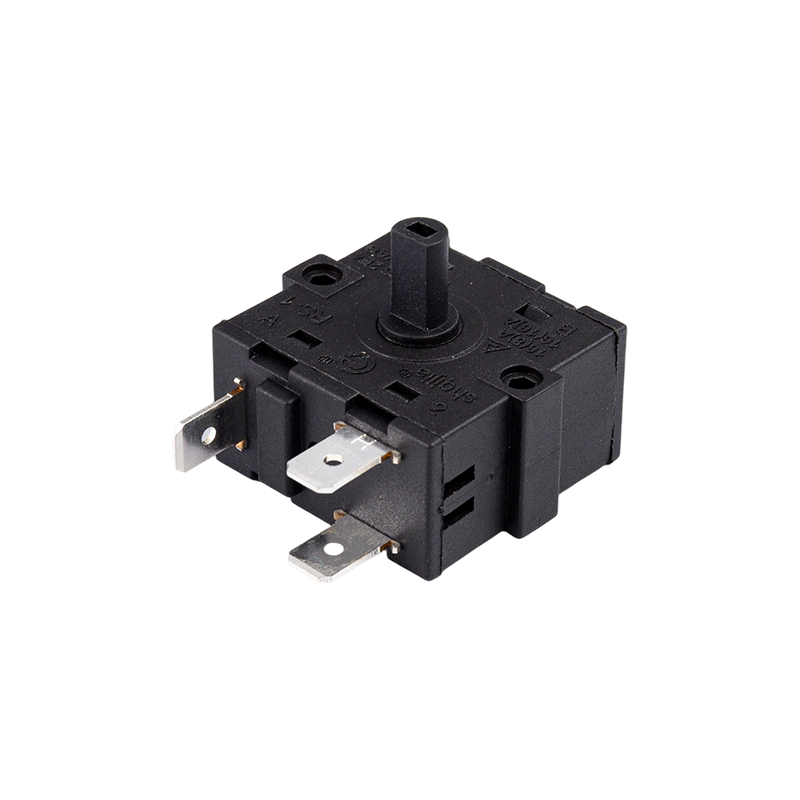
A rotary selector switch is the most common type of knob switch encountered in industrial and commercial applications. It has a fixed number of discrete positions — typically 2 to 12 — each corresponding to a specific circuit state. When the knob is turned to a position, an internal cam or contact bridge connects or disconnects specific poles, making it suitable for selecting between operational modes, speed settings, input sources, or control functions. Industrial rotary selector switches are available in 16mm, 22mm, and 30mm panel cutout sizes to match standard control panel systems from manufacturers such as Schneider Electric, Siemens, ABB, and Eaton. They can be configured as maintained (stays in position when released) or spring-return (returns to a default position when released), and many accept padlocking accessories for lockout-tagout safety compliance.
Rotary Potentiometer Knob
While technically a variable resistor rather than a switch, potentiometer knobs are functionally classified alongside knob switches in the context of panel controls because they share the same physical interface — a rotating knob — and serve a similar control function. A potentiometer knob varies a resistance value continuously as the knob rotates, controlling parameters such as volume, brightness, motor speed, or signal level. Linear taper potentiometers provide a resistance change proportional to the angle of rotation, while audio taper (logarithmic) potentiometers match the non-linear sensitivity of human hearing and are used in audio equipment. Rotary potentiometer knobs are found on audio amplifiers, lighting dimmers, laboratory instruments, and any application requiring smooth, continuously variable control rather than discrete position selection.
Rotary Encoder Knob Switch
A rotary encoder knob converts rotational position or movement into a digital electrical signal — typically a series of pulses — that a microcontroller or digital system can interpret. Unlike potentiometers that measure absolute angular position through resistance, encoders measure incremental rotation (how far and in which direction the knob has been turned) without a fixed end stop, allowing unlimited rotation. Many rotary encoder knobs also incorporate a push-button function activated by pressing the knob axially. These are extensively used in modern digital equipment — car audio head units, industrial HMI panels, medical device controls, and consumer electronics — where a single knob must provide both navigation and selection functions in a digital menu interface.
Multi-Position Band Switch
Band switches — also called wafer switches or deck switches — are multi-position rotary knob switches with multiple switching layers (wafers or decks) stacked on a common shaft. Each wafer is an independent switching circuit, and all wafers rotate simultaneously when the knob is turned. This allows a single knob to simultaneously control multiple independent circuits, making band switches popular in radio and audio equipment for switching between frequency bands, input channels, or equalizer settings. A single 12-position 4-deck band switch can control four separate circuits through 12 positions each using one knob, replacing what would otherwise require four separate switches.
Key Switch with Knob
Key-operated rotary switches use a removable key as the operating knob, providing access control to the switching function. The key must be inserted to operate the switch, and can only be removed in specific positions — typically the OFF position — preventing unauthorized operation or ensuring the switch cannot be left in an intermediate position. Key switches are used on industrial machinery, security panels, elevator controls, server room equipment, and any application where restricting switching access is a safety or security requirement. They are available in maintained and spring-return configurations and comply with key profile standards that allow keying-alike (one key operates multiple switches) or keying-different setups.
Key Electrical Specifications of Knob Switches
Selecting a knob switch that will perform reliably over its intended service life requires careful attention to electrical specifications. Installing an undersized switch — one that operates at or above its rated limits — leads to contact erosion, overheating, increased contact resistance, and eventually switch failure or fire risk.
| Specification | What It Means | Practical Guidance |
| Rated Voltage | Maximum voltage the switch can safely interrupt | Always select a switch rated above your circuit voltage with margin |
| Rated Current | Maximum continuous current through contacts | Derate by 20–30% for inductive loads vs. resistive ratings |
| Contact Configuration (Poles and Throws) | Number of independent circuits (poles) and positions per pole (throws) | Match to circuit requirements: SPDT, DPDT, 3P, 4P etc. |
| Number of Positions | Discrete switching positions available | Select to match the number of modes or circuits to be controlled |
| Contact Material | Material used for the switching contacts | Silver alloy for power; gold plating for low-level signal switching |
| Mechanical Life (Operations) | Number of switching cycles before mechanical wear | Typically 50,000–500,000 cycles; match to expected use frequency |
| Electrical Life (Operations) | Number of switching cycles under rated electrical load | Usually lower than mechanical life; verify for high-cycle applications |
| IP Rating | Protection against dust and water ingress | IP65 or higher needed for outdoor or washdown environments |
Materials and Construction of Knob Switches
The physical construction of a knob switch — particularly the knob itself and the switch body — directly affects its durability, operating feel, environmental resistance, and suitability for different installation environments. Understanding material choices helps specify the right switch for the operating conditions.
Knob Materials
The knob is the part the operator touches and sees, so its material affects both function and aesthetics. Phenolic resin (Bakelite) was the dominant knob material for decades and remains popular for its excellent electrical insulation, heat resistance, chemical resistance, and classic appearance. It is still widely used on industrial controls and audio equipment. ABS and polycarbonate thermoplastics are used in modern consumer and commercial equipment, offering lighter weight, broader color range, and lower cost than phenolic, though with somewhat lower heat resistance. Aluminum knobs — typically anodized or knurled — are preferred in premium audio, laboratory, and professional equipment where tactile quality, mechanical precision, and aesthetics are priorities. Zinc die-cast knobs offer a heavier feel and are used in applications where perceived quality and robustness matter to the user.
Switch Body and Housing Materials
Industrial rotary selector switch bodies are typically constructed from glass-fiber reinforced polyamide (PA66-GF) or polycarbonate, both of which offer excellent flame retardancy, dimensional stability across temperature ranges, and resistance to the cleaning solvents and lubricants found in industrial environments. Metal front rings — usually zinc die-cast with nickel plating — provide a robust, professional appearance on panel-mounted industrial switches. For outdoor or harsh environment applications, switch bodies must achieve IP65 or IP67 ratings, requiring careful gasket sealing between the knob shaft and the front panel, and sealed cable entry points at the rear of the switch body.
Contact Materials
The contact material determines the switch's electrical performance, contact resistance stability over life, and suitability for different load types. Silver cadmium oxide (AgCdO) contacts were the industry standard for power switching for many years due to their excellent arc resistance and low contact welding tendency, but environmental regulations have driven a transition toward silver tin oxide (AgSnO₂) as a cadmium-free alternative with comparable performance. Silver nickel (AgNi) contacts are used where moderate current carrying capacity and good wear resistance are required at lower cost. For low-level signal switching — logic signals, instrumentation circuits, audio — gold-plated contacts are essential because gold does not oxidize, maintaining stable, low-resistance contact even at the micro-amp current levels where silver oxide films would cause intermittent contact.
Where Knob Switches Are Used: Key Applications by Industry
Control knob switches appear in virtually every industry sector and product category where human operators need to select between modes, adjust settings, or control equipment. Here is how they are applied across major application areas:
Industrial Control Panels and Machinery
Industrial control panels use rotary selector knob switches for motor speed selection, operating mode selection (manual/automatic/off), pump selector switches, valve position controls, and fault reset functions. Standard 22mm and 30mm format selector switches from industrial automation suppliers dominate this market, offering modular contact blocks that can be assembled to create virtually any pole and position combination. These switches must comply with IEC 60947-5-1 for low-voltage control circuit devices and are typically UL listed for the North American market. The availability of lockable versions — accepting standard padlocks through a hole in the knob when turned to the OFF position — makes rotary selector switches the preferred choice for energy isolation and lockout-tagout compliance on industrial machinery.
Home Appliances and HVAC Equipment
Knob switches on domestic appliances — cooker hobs, washing machine program selectors, oven temperature controls, fan speed selectors, and air conditioning mode switches — are among the most frequently operated switches in everyday life. Appliance-grade rotary knob switches must meet specific safety standards (IEC 61058-1 for appliance switches) and are designed for high cycle life and resistance to grease, steam, and cleaning chemicals. Many modern appliance knob switches incorporate a push-to-turn safety interlock that prevents accidental activation, particularly important on gas hob ignition controls where inadvertent rotation could open a gas valve without ignition.
Audio and Professional AV Equipment
Audio and professional AV equipment makes extensive use of both potentiometer knobs (for volume, tone, and level controls) and rotary selector knobs (for input selection, filter selection, and mode switching). In professional audio, the quality of the knob switch is closely linked to the perceived and actual quality of the equipment — a smooth, well-damped rotary feel with no mechanical play communicates precision and reliability to the operator. High-end audio equipment uses conductive plastic or cermet potentiometers rather than carbon film types for their superior noise performance, better channel tracking in stereo applications, and longer service life.
Automotive Controls
Vehicles use rotary knob switches for climate control (temperature and fan speed), lighting mode selection, drive mode selection, and audio system control. Automotive-grade rotary switches must withstand extreme temperature ranges (typically -40°C to +85°C operating), vibration and shock loads from road use, and exposure to UV, humidity, and cleaning chemicals. Illuminated knob switches — with LED backlighting integrated into the knob or its surround — are standard in modern vehicle interiors for nighttime visibility. Haptic feedback mechanisms that provide a distinct tactile click at each position are a mandatory feature to allow eyes-free operation while driving.
Medical and Laboratory Instruments
Medical devices and laboratory instruments use knob switches for parameter selection, measurement range switching, and operating mode control. In these applications, precision, reliability, and cleanability are the overriding requirements. Sealed knob switches with no crevices that could harbor contamination are essential in clinical environments, and switches used on patient-connected equipment must comply with IEC 60601-1 medical electrical equipment safety standards. Laboratory instruments such as oscilloscopes, spectrum analyzers, and power supplies use high-quality rotary encoder knobs extensively, allowing the operator to navigate menus and adjust values with a precision and speed that push buttons cannot match.
Maintained vs. Spring-Return Knob Switches: When to Use Each
One of the most practically important distinctions in knob switch selection is between maintained-position and spring-return operation — a choice that directly affects how the switch behaves when the operator releases it, and therefore how it must be incorporated into control system logic.
A maintained-position knob switch stays exactly where it is set after the operator turns and releases it. The circuit state corresponding to the selected position is held continuously until the operator deliberately turns the knob to a different position. This is the appropriate choice for any control function where the selected state must persist — motor run/stop selection, operating mode selection, speed setting, or input source selection. The majority of industrial selector switches and appliance program selectors are maintained types. The visual position of the knob immediately communicates the current system state to any observer, which is a significant operational safety advantage on machinery control panels.
A spring-return knob switch is held in its selected position only while the operator actively holds it there. When released, an internal torsion spring returns the knob to its default (usually center or OFF) position. Spring-return knob switches are used for momentary control functions — jog controls on machine tools, hold-to-run safety circuits, emergency override functions, and spring-return START/STOP controls where the control command should only be active for as long as the operator is consciously holding it. They are a key component in safety-critical control applications where an inadvertently latched-ON state could create a hazard if the operator becomes incapacitated.
Illuminated Knob Switches: Types and Practical Benefits
Illuminated rotary knob switches incorporate a light source — traditionally an incandescent or neon lamp, but now almost universally LED — that provides visual feedback about the switch's operational state, the selected position, or simply improves panel visibility in low-light conditions. They are widely used in industrial panels, vehicle dashboards, audio equipment, and consumer appliances.
- Position indicator illumination: Some illuminated knob switches light up the selected position indicator on the panel fascia, making it immediately clear which mode or setting is active even from a distance or in poor lighting conditions. This is particularly valuable on complex multi-function control panels where many switches are present.
- Status indicator illumination: Other designs illuminate the knob itself or a surrounding ring to indicate operational status — for example, a green-illuminated ring when the controlled equipment is running, or a red illumination when a fault condition is present. This integrates the control and indication functions into a single panel component, saving space and wiring.
- LED vs. incandescent lamp life: Modern industrial LED-illuminated knob switches have rated lamp lives of 50,000–100,000 hours, compared to 5,000–10,000 hours for incandescent lamp versions. In continuously operated industrial equipment, this translates to decades of maintenance-free illumination versus annual lamp replacements — a significant long-term maintenance cost difference.
- Color coding: Illuminated knob switches are available in multiple LED colors — green, red, amber, blue, white — that can be used systematically to communicate operational status across a panel. Standardized color conventions (green = running/safe, red = fault/stop, amber = warning/standby) improve operator comprehension and reduce the risk of control errors.
How to Choose the Right Knob Switch for Your Application
Specifying the correct rotary knob switch requires working systematically through the electrical, mechanical, environmental, and functional requirements of the application. Overlooking any one of these dimensions is a common cause of switch failures, safety incidents, or costly redesigns.
- Define the switching function first: Determine whether you need discrete position switching (rotary selector), continuous variable control (potentiometer), digital incremental control (encoder), or momentary switching (spring-return selector). This choice defines the switch family before any other parameter is considered.
- Establish electrical load requirements: Identify the circuit voltage, the maximum continuous current, and the load type (resistive, inductive, or capacitive). For inductive loads such as motor starters and solenoids, apply a derating factor of at least 30% to the contact current rating to account for the higher arc energy generated when switching inductive circuits.
- Determine the number of positions and poles needed: Count the number of discrete circuit states required (positions) and the number of independent circuits that must be simultaneously switched (poles). Verify that a standard switch configuration meets your requirements, or that a custom contact block assembly is available if needed.
- Assess the operating environment: Consider ambient temperature range, exposure to dust, moisture, oils, or chemical vapors, and the risk of accidental impact or vibration. Select an IP rating appropriate to the environment — IP65 as a minimum for any outdoor or washdown application — and verify the temperature range covers your installation conditions including both storage and operating extremes.
- Check panel cutout and mounting compatibility: Standard industrial selector switches use 16mm, 22mm, or 30mm round panel cutouts. Verify that your panel material thickness is within the switch's specified range for secure mounting. For equipment that must meet specific standards (UL, CE, IECEx, ATEX), confirm the switch carries the required certification marks before ordering.
- Consider operator interface requirements: Think about the knob size and profile relative to operator ergonomics — a large-diameter knob is easier to operate with gloved hands in industrial environments. Consider whether illumination is needed for low-light operation or status indication. If access control is required, specify a key switch or padlockable version.
- Verify cycle life against expected use: Estimate the number of switching operations the switch will perform over its intended service life. For high-cycle applications — frequently operated mode selectors or continuously adjusted controls — select switches with published electrical life ratings that comfortably exceed your calculated operational requirement, and plan a preventive replacement interval before the rated life is reached.
Installation, Wiring, and Maintenance Tips for Knob Switches
Even a correctly specified knob switch will fail prematurely or perform unreliably if it is poorly installed, incorrectly wired, or not maintained. These practical guidelines apply across most types of panel-mounted rotary knob switches.
Correct Panel Installation
Cut the panel hole to the switch manufacturer's specified diameter tolerance — typically +0.1/-0mm for a snug fit in most 22mm industrial switches. Deburr the hole edges thoroughly to avoid cutting the switch's front seal gasket during installation. Tighten the switch retaining nut to the manufacturer's specified torque — overtightening crushes the gasket and can crack the switch body; undertightening allows the switch to rotate in the panel or reduces IP protection effectiveness. For switches installed in painted or powder-coated panels, ensure the paint is removed from the mounting area so that the metal panel makes good ground contact with the switch's metal front ring where required by the circuit design.
Wiring Best Practices
Follow the wiring diagram provided with the switch carefully — rotary selector switch contact blocks can have non-obvious contact connection sequences depending on the number of positions and the cam configuration used. Use ferrule-terminated conductors for screw terminal connections to prevent loose strand insertion that can cause high resistance joints. Observe the manufacturer's recommended conductor cross-section range — both minimum and maximum — as oversized conductors can prevent the terminal cover from closing, compromising IP protection. Always verify the wired circuit function with a continuity or function test before closing the panel and energizing the system.
Routine Maintenance and Fault Finding
Knob switches in industrial environments should be included in periodic maintenance schedules. Inspect the knob and panel seal annually for signs of physical damage, chemical attack, or UV degradation. Check that the knob operates smoothly through all positions without stiffness, binding, or looseness that could indicate internal wear or contamination. For switches in dusty environments, use appropriate contact cleaning spray on accessible contact surfaces to remove oxidation or contamination that increases contact resistance. If a switch shows intermittent circuit continuity, erratic operation, or burning or discoloration around the terminals, replace it immediately rather than attempting to repair it — internal contact damage in a loaded circuit switch is a potential fire hazard that cannot be safely remedied by cleaning alone.


A Appliance Switches Manufacturer that has been focusing on the development, production and sales of Switches for 21 years;
Products Links
Contact Information
Tel: +86-021-33752188
Phone: +86-13524812989
E-Mail: [email protected]
[email protected]
[email protected]Address: No. 580 Shenzhou Road, Fengxian District, Shanghai, China

